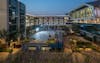
Alibaba Xixi Campus (Park C)
Alibaba Xixi Campus (Park C) in Hangzhou serves the needs of a community of 30,000 people by providing a network of lush, biophilic spaces.
This project strives to set a new standard for integrating immersive, nature-based landscapes within complex built environments. As a blueprint for future urban developments, it exemplifies ASPECT Studios’ commitment to designing places where natural systems and human-centered spaces converge, fostering social vibrancy, biodiversity, and ecological resilience.
The project is built entirely atop a multistorey podium structure. Sophisticated engineering solutions, optimised soil depths, innovative water harvesting systems and adaptive planting strategies have enabled the creation of a flourishing celebration of nature in this inhospitable environment.
This project strives to set a new standard for integrating immersive, nature-based landscapes within complex built environments. As a blueprint for future urban developments, it exemplifies ASPECT Studios’ commitment to designing places where natural systems and human-centered spaces converge, fostering social vibrancy, biodiversity, and ecological resilience.
The project is built entirely atop a multistorey podium structure. Sophisticated engineering solutions, optimised soil depths, innovative water harvesting systems and adaptive planting strategies have enabled the creation of a flourishing celebration of nature in this inhospitable environment.
- CLIENT Alibaba
- LOCATION Hangzhou, Zhejiang Province, China
- YEAR 2024


Weaving water
Using an algorithmic analysis of stormwater, ASPECT Studios carefully designed a series of bio-swales and stormwater channels that form a network of “veins” throughout the campus, capturing water and feeding it into the central lake. This system, which mimics those found in nature, slows, filters and absorbs runoff, reducing flood risk and replenishing groundwater.
The central lake serves as both a stormwater reservoir and an irrigation source, supporting the park through drier periods, while also being the centerpiece of the community and event program. At its heart sits a pavilion that sweeps above and alongside the water, creating a terrace that brings people close to the water and each other.
The central lake serves as both a stormwater reservoir and an irrigation source, supporting the park through drier periods, while also being the centerpiece of the community and event program. At its heart sits a pavilion that sweeps above and alongside the water, creating a terrace that brings people close to the water and each other.
By integrating water into the foundational thinking of the design, water is protected as a natural resource, and resilience and ecological performance is improved.
Read more +


A campus landscape
At the core of the campus landscape is a humanistic design philosophy—one which attempts to improve people’s daily lives through diversity of experience, improved connectivity, and enhanced wellbeing.
The design prioritizes the individual and collective needs of its users, fostering an inclusive, dynamic atmosphere where people can work, relax, and interact in ways that support both their personal and professional growth. This vision is realised through open and accessible spaces that encourage movement, exploration, and collaboration.
Strategically positioned across the campus based on population flow, movement patterns and sunlight analysis, several floating architectural elements - or “halo canopies” - provide shade, shelter and a visual identity for the park.
The design prioritizes the individual and collective needs of its users, fostering an inclusive, dynamic atmosphere where people can work, relax, and interact in ways that support both their personal and professional growth. This vision is realised through open and accessible spaces that encourage movement, exploration, and collaboration.
Strategically positioned across the campus based on population flow, movement patterns and sunlight analysis, several floating architectural elements - or “halo canopies” - provide shade, shelter and a visual identity for the park.

The BioHabiNet
Central to the design was the “BioHabiNet” concept, an evidence-based design framework that integrates biodiversity, sustainable water systems, habitats, and community-oriented spaces. The project:
— Establishes a biodiverse ecosystem across the campus that responds to the local microclimate (Bio)
— Creates a healthy habitat for both wildlife and people (Habi)
— Forges an organic, cellular series of interconnective networks (Net)
The BioHabiNet framework was devised to provide a pathway for future developments in complex urban environments that are based on dynamic curation of natural systems. This thinking—which values water, biodiversity and people as key elements of good built environment design - could easily be applied elsewhere.
— Establishes a biodiverse ecosystem across the campus that responds to the local microclimate (Bio)
— Creates a healthy habitat for both wildlife and people (Habi)
— Forges an organic, cellular series of interconnective networks (Net)
The BioHabiNet framework was devised to provide a pathway for future developments in complex urban environments that are based on dynamic curation of natural systems. This thinking—which values water, biodiversity and people as key elements of good built environment design - could easily be applied elsewhere.


Setting new standards
The Alibaba Xixi Campus (Park C) is more than a workplace landscape. It is an attempt to set new standards for urban resilience, the integration of natural systems, and human-centred design within the confines of a complex multi layered build environment.
- TEAM Nihon Sekkei, Tongji Architectural Design (Group) Co., Ltd., Hangzhou Landscape Architecture Design Institute Co., Ltd.
- PHOTOGRAPHY Wang Wenjie