The park after dark: Stretching the use of urban spaces
As public space in our cities becomes more contested—in terms of their increased use, growing land value and environmental stress—are we getting the most out of our parks? Why, in Australia, do many of our urban inner city public parks become dark, unused, antisocial spaces in the evening? Here, Bianca Pineda, Associate Studio Director, uses her experience as a designer and user of public spaces in Sydney and elsewhere to explore the possibilities of the urban park after dark—and explores how we can that expand the way we use our existing parks is the key to improving the urban experience.

What if we could dramatically increase access to urban parks—and all the social, physical, and mental health benefits they offer—without building a single one? Urban space is precious. And expensive. In many places, the dream of adding more green space is politically fraught or simply unaffordable. But there’s another way to grow: not outwards, but over time. By extending the hours our parks remain open, we can offer more people more access without expanding our physical footprint. As cities rush to become more “24-hour” in their cultural and economic life, our public spaces too often remain stuck in the 9-to-5 paradigm. Why should our parks, the most democratic and essential piece of civic infrastructure, not be part of this expanded vision?
UNICEF underscores the importance of outdoor play, recommending young children spend at least three hours outdoors a day, a challenge for most working families.
According to the 2023 Safer Cities Survey by Transport for NSW, nearly 59 percent of women report feeling unsafe in public spaces after dark, compared with only 32 percent of men. Research from Monash University’s XYX Lab, working with the crowd-mapping initiative YourGround NSW, shows how these perceptions of danger influence women’s movements, shaping decisions about when, where and whether they go out at all. At the same time, densification in our cities is increasing competition for limited shared spaces.
These issues, which relate to safety, health and access, are not isolated. Together they raise a crucial question: how do we design public space to reflect the full range of how people actually live, rather than how we assume they want to?
There are practical considerations too. The ecological impacts of lighting and activity at night; the cost of maintaining and managing public spaces beyond daylight hours; and the NIMBY effect of neighbours who may not be welcoming to these changes.

The idea I’m proposing is simple: urban parks should be designed not just for daytime use, but for life after dark. That means being creative - about lighting, programming, and governance. It means working with communities, not against them. And it means recognising that access, equity, and joy in public space shouldn’t disappear with the sun.
Our cities have a huge amount to gain from embracing the idea of a night-time park.
For one, extending the temporal reach of our parks, keeping them open later or even around the clock, allows us to dramatically increase access to open space without building any more of them. In dense urban environments, where land is increasingly scarce and costly, that’s a profound opportunity. For resource-constrained local governments, it’s also a cost-effective way to do more with what we already have.
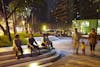
Urban parks are increasingly overburdened as our cities grow upward and inward. And yet, the demand for safe and accessible public space continues to climb, especially for families like mine. Young children are recommended to spend three hours outdoors each day. This is challenging at the best of times for working parents juggling daycare drop-offs and late pickups, especially during winter’s shorter days. The chance to stop at a local playground after hours to burn off some toddler energy would make a tangible difference to my family’s wellbeing.
Teenagers, too, are often overlooked in how we program and design public space. They need places to gather that are safe, welcoming, and age-appropriate - not always easy to find in the city. A well-lit, open park could be a great alternative to loitering in shopping centres or hanging out in car parks. It could also be a rare offering of autonomy and dignity in a built environment that often treats them as a problem to be managed.
And of course, there’s the question of equity. Who gets to enjoy the benefits of the city, and when? The ability to go for a run after dark or walk a dog in peace shouldn’t be a luxury from which shift workers, parents, students, and anyone else who simply can’t fit their life into daylight hours should be excluded.
By extending the life of our parks beyond the constraints of the 9-to-5 city, we don’t just ease the pressure on urban green space, we offer a richer, more inclusive civic life to everyone who calls the city home.

Lighting plays a big role, but so do shade, materials, access to parking and proximity to dense residential areas. Well-designed microclimates support this evening rhythm, and cultural practices, such as night-time gatherings during Ramadan, help sustain it. The result is a public realm where evening use is normal rather than exceptional. Design and governance work together: strong illumination, high amenity and a sense of safety make night activity feel not only possible but routine.
This highlights an important point: this concept is not just about lighting, or about disrupting the natural systems that are hard at work once the sun goes down. It is about thinking about the park after dark as a totality and using design to surface the most useful elements.
Nearby, the ICC forecourt provides another example. What began as an informal place for dancers to practise, often overlooked in the rush of daytime programming, has now been recognised and supported in recent upgrades. The design simply reinforced existing behaviour and signalled that night-time activity is something to be welcomed rather than discouraged.


Local councils are also making practical moves to keep parks open later, especially during winter. What began during COVID as a temporary measure to support evening exercise through improved lighting has become permanent in several LGAs. The policy thinking is clear: if parks support public health, they need to be available when people are free to use them.
Lighting and activity matter, but they do not fully explain the sense of welcome that makes a night-time park feel safe and intuitive. In parts of Europe, modest kiosks help extend the sociability of public space into the evening. They are popular not because they provide entertainment but because they give people a reason to stay a little longer. While Australia has regulatory concerns around public drinking and late-night culture, the broader point remains: people feel safer in places where others are already present.
There is also an overlooked cultural dimension. In places where drinking is uncommon, parks play a different social role. They become the default evening gathering place, an intergenerational commons rather than an extension of nightlife. This is an appealing idea. It suggests our urban spaces could support a wider range of ways to socialise in the evening, rather than the narrow set of activities we currently rely on.

None of this is as difficult as it first seems. The idea of the night-time park may feel new, but their constituent parts already exist elsewhere in the world, in small pockets of our own cities, and in the informal ways our communities already use public space after dark. As landscape architects and urban designers—we need to channel this into a more deliberate approach in our projects.
If our cities are to be more inclusive, resilient and welcoming, access to public space cannot disappear with the daylight. Extending the hours in which parks can operate is a simple and effective way to give more people access to more of the city, without needing to build anything new. It lets us grow not by expanding outwards, but by expanding in time.
This may be the real opportunity: to imagine our parks not as daytime amenities, but as places that support the full and varied rhythms of contemporary urban life.
- https://www.transport.nsw.gov.au/system/files/media/documents/2023/Safer-Cities_Survey-Report_0.pdf
- https://www.yourground.org/