The Green Factor arrives in Melbourne

Here, Warwick Savvas, Senior Associate from ASPECT Studios Melbourne, explains how the City of Melbourne's Green Factor Tool will require private developments to meet measurable greening requirements, and how ASPECT Studios can help projects achieve the required 0.55 score.
Our cities are composed of infrastructure, built from ubiquitous concrete, glass, and steel. We have built our roads, buildings and the networks that supply us with power, data and water by excluding nature.
As a result, even in the greenest cities there is not much nature left. And generally, what green space exists can be found in the public realm is considered the responsibility of the public realm with very little on private land.
To a certain degree, city authorities can influence and even control what is constructed on public land, and they have long been strong (and sometimes the only) advocates for public green spaces.
But it is much more difficult to control what development occurs within the private domain.

The financial and economic pressures on developments do not easily yield to the inclusion of green space. This is despite the surmounting and unignorable body of verifiable evidence that points to the fact that we need to change how are cities are built, rebuilt and maintained, if we are to avoid continued declines in the quality of urban life.
Recently the City of Melbourne voted in favor of Planning Scheme Amendment C376, which now only needs to pass the final step of ministerial sign off before it becomes law.
The proposed changes have been designed to ensure future development mitigates and adapts to the effects of climate change. The amended planning rules will ensure future development achieves best practice in Environmentally Sustainable Design, including increased energy efficiency and the greening of buildings. This last part is important and includes a measurable requirement to increase the amount of urban green infrastructure to meet a required 0.55 Green Factor Tool score.


It involves planting integrated into a built form by way of green roofs, green walls, green facades at height, and the on-ground inclusion of planted gardens and trees.
Urban Green Infrastructure is incredibly important for those of us concerned with the relationship of the built environment to broader environmental and climactic concerns. It aligns closely with the UN Sustainable Development Goals and fostering a sustainable future for both communities and nature.
Urban green infrastructure enhances visual amenity by activating the innate attraction we have as humans to nature. Studies link this directly to improvements in our mental health, productivity and overall happiness. Simply being able to see plants improves our wellbeing.
Urban greening also helps makes our cities better by managing stormwater, improving air quality and importantly reducing temperatures on hot days.
It also provides habitat for animals which enhances biodiversity in urban areas and provides essential 'stepping stones' for migratory species and supports local wildlife.
We need to find ways to incorporate nature into our cities especially in the face of increasing urbanisation and the effects of climate change. If we do not do this our future is bleak and will be dominated by cities with a dearth of nature, that are hot dusty and inhospitable.
Without green infrastructure our cities will become increasingly unliveable.

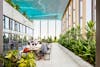
Even with the known benefits these concerns often win out and greening does not get serious consideration.
That is why the city of Melbourne has stepped in to provide some strong requirements that greening get included into projects.
In the Northern Hemisphere the primary drivers for this are the management of stormwater volume and quality, as well as biodiversity loss and the imminent threat to bee populations.
In Melbourne, the primary driver is human wellbeing. This is a combination of heat impacts, and general wellbeing and access to nature. Stormwater is also an important benefit – and these measures will assist developers in meeting their mandatory Water Sensitive Urban Design obligations.
Greening has the dual benefit of reducing the Urban Heat Island impacts of the city generally, and saving energy costs for cooling the building that it is incorporated onto.

As more projects include these elements the industry expertise and capacity will increase, costs will come down and the quality of outcome of greening projects will continue to improve.

We can work with developers, architects and engineers to achieve a 0.55 Green Factor Tool score in the most efficient and beneficial way that will also be long-lasting, resilient, and require the minimum of maintenance.
The prospects for our cities just got a lot greener.